
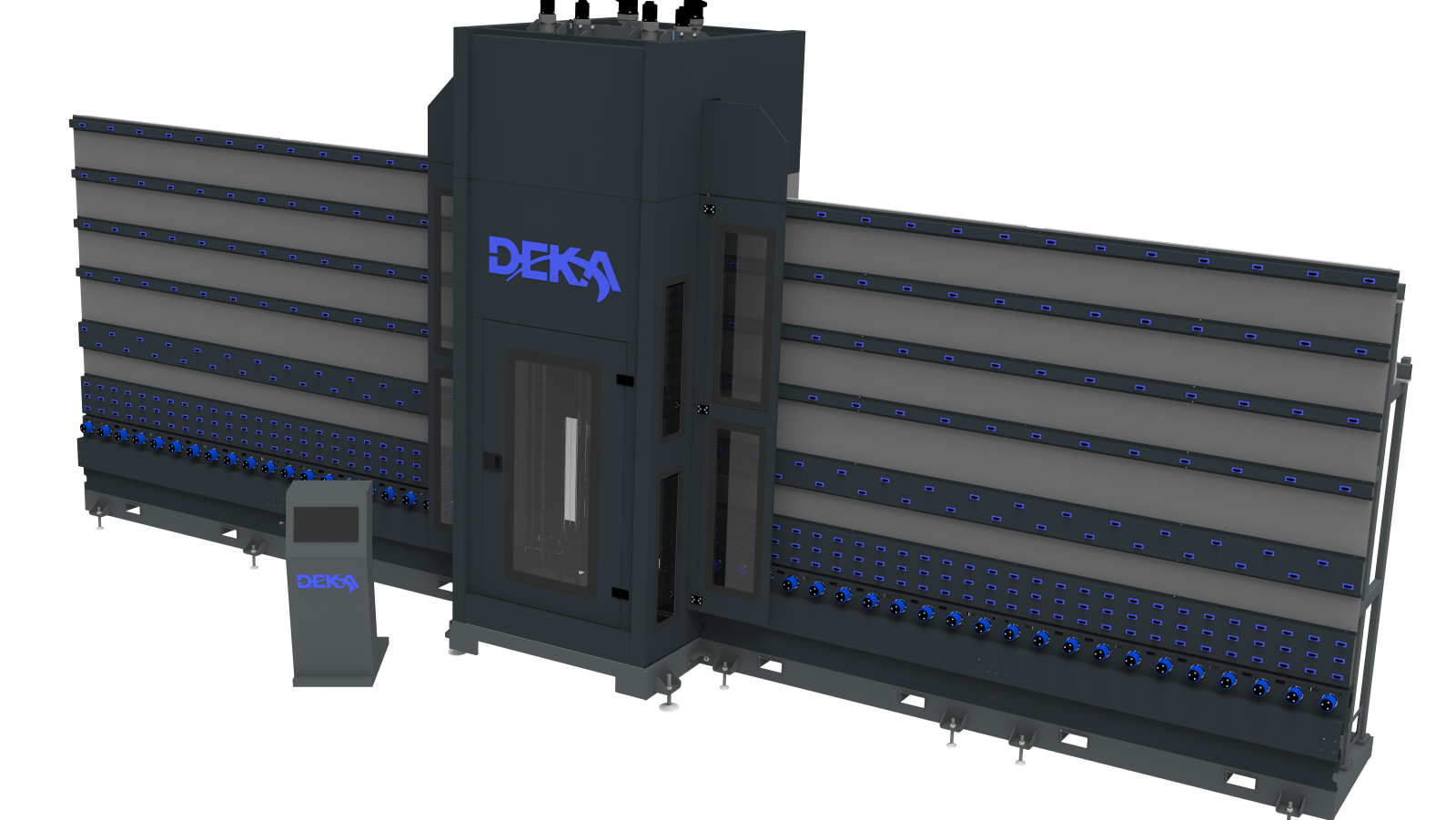
What is a DKDT Glass Grinding Machine, and Why is it Essential?
Glass grinding machine (also known as a glass grinder or deburring machine) is a machine that processes the sharp, micro-cracked edges of glass after cutting, making them smooth, safe, and durable. Although the edge of the cut glass may appear smooth to the naked eye, it contains microscopic notches and cracks; these notches are the starting point of fracture under stress.
Types of break-in and terminology
Let's clarify some commonly confused terms in the industry:
Deburring (seaming / arrissing): Edge sharpening. This is a fundamental process; its purpose is not aesthetics, but safety and fracture resistance. It is a minimum requirement in tempering and insulating glass production lines.
Straight break-in period: The edge is made into a smooth surface. The visible edge of the glass remains matte.
High-gloss polishing: Edge polishing after smooth grinding. This is preferred for applications where the edge remains visible, such as shower enclosures, table glass, and display cases.
Corner and radius: Breaking or rounding off sharp edges reduces the risk of injury during handling.
Why can't the break-in period be skipped before tempering?
During tempering, glass is heated to approximately 620-650 °C and then rapidly cooled. This process creates compressive stress on the surface and tensile stress in the interior — this is what strengthens the glass. However, if there is an untreated microcrack at the edge, this stress represents a new force that will enlarge it. The result: the glass shatters in the furnace or shortly after it leaves the furnace. Every piece of glass entering the tempering furnace must have its edges precisely treated.
In insulating glass production, untreated edges, spacers, and bonding sealants prevent full contact between the glass and the sealant. The result is a loss of sealing and condensation inside the unit in the long term.
How many millimeters of break-in machine should I buy?
In break-in machines shaft The number of spindles determines how many steps the edge is machined. Each spindle carries a stone of a different grit size; the process progresses from coarse to fine stone.
Low-production machines (e.g., 4-6 mil) is more economical and sufficient for deburring and smooth grinding. This is often sufficient in production feeding tempering and insulated glass lines.
Multinational machines (8-12 miles and above) Completes all stages from rough grinding to polishing in a single pass. Preferred for products where the edge remains visible and for lines requiring high speed. The rule is simple: If you want to achieve the same quality in fewer miles, you have to reduce the speed.
Three questions to ask when making a decision: Will the edge remain visible? How many linear meters of edge will you process per day? What is the speed of the other units on the line?
Our Break-in and Grinding Solutions
Do you need a machine that only performs edge finishing, or a machining center that also performs drilling and milling in addition to grinding? Compare the solutions below.
FSR Vertical CNC Glass Processing Center
FSR vertical CNC glass processing center: drilling, milling, grinding and shape cutting in a single machine. Low space requirement and fast preparation thanks to vertical positioning.
FSR Vertical CNC Glass Processing Center
VGWM Vertical Window Washing Machine
VGWM vertical glass cleaning machine: brush configuration for insulated and Low-E glass, demineralized water circuit and drying. Spotless surface for butyl adhesion.
VGWM Vertical Window Washing Machine
DKDT Vertical Glass Grinding and Edge Grinding Machine
DKDT vertical glass edging and grinding machine: edge preparation for pre-tempering, including band, flat, C-shaped, and profile edging. The number of spindles is configured according to your production line.
DKDT Vertical Glass Grinding and Edge Grinding Machine
DD6 Vertical Glass Drilling Machine
DD6 vertical glass drilling machine: drills and countersinks in flat, shaped, and laminated glass. Torque control reduces the risk of cracking and output chipping. Manufactured by Deka Makine.
DD6 Vertical Glass Drilling Machine
Glass Grinding — Frequently Asked Questions
What is the difference between break-in, grinding, and deburring?
Why is break-in before tempering necessary?
How many millimeters of machine should I buy?
Where is it located in the insulating glass line?
Is edge processing possible on Low-E coated glass?
Technical and Service
Does it include installation and operator training?
How does after-sales technical support work?
How can I extend the lifespan of my stone?
How long does it take to get spare parts?
Can the machine be integrated into my existing production line?
Get a quote for a glass grinding machine.
Share your daily edge processing capacity, glass thickness range, and target edge quality; let's determine the appropriate configuration together.